
 English
 Русский
 Español
 Français
 Deutsch
 简体中文
 Árabe
 Português
 日本語
 한국어
 हिंदी
 Prancis
 Türkçe
 Tiếng Việt
 Italiano
 ไทย

Alumina Grinding Media Size Selection for Ball Mills
Alumina Grinding Media Size Selection for Ball Mills
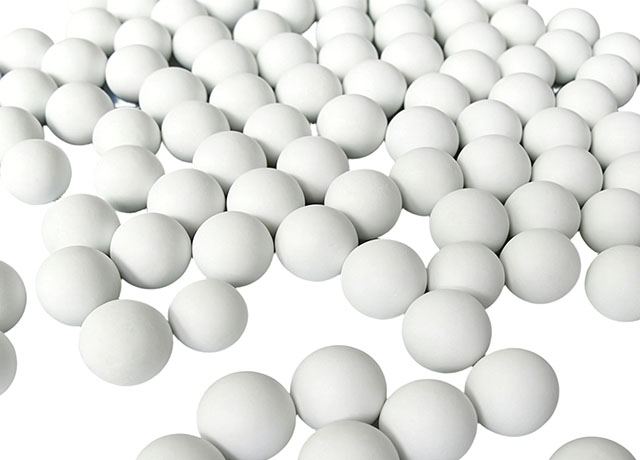
Choosing the right grinding ball size is important for stable milling performance. Balls that are too small may not provide enough impact to break coarse particles. Balls that are too large may provide fewer contact points for fine grinding.
For manufacturers processing ceramics, minerals, pigments, and other powders, the goal is to match grinding media to the feed material and required product size.
Alumina grinding media are used in applications where wear resistance and control of metal contamination are important. However, the best ball diameter also depends on mill type, material hardness, loading conditions, and grinding time. Research shows that media size and feed particle size work together to affect grinding results. [1][2]
Match Ball Size to Feed Particle Size
Feed particle size is one of the first factors to consider.
Coarse feed: Larger grinding balls may provide stronger impacts to break larger particles. They are often considered when the material needs substantial size reduction.
Fine feed: Smaller balls provide more contact points for a comparable media volume. They may be useful when the feed is already fine and the process needs further particle-size reduction.
Mixed-size feed: A combination of ball sizes may help process materials with different particle sizes. Larger balls can break coarse particles, while smaller balls provide more contact points for finer material. However, mixed-size media are not always better. Testing under actual operating conditions is needed. [1][2]
The material's hardness and the mill's operating conditions also affect the result. Do not select grinding media based on feed size alone.
Consider the Target Product Fineness
The required final particle size affects the choice of grinding media.
For moderate size reduction, larger balls may provide enough impact. For fine grinding, smaller balls may increase the number of contact points, provided they still have enough energy to break the particles.
A 2024 study on quartz sand in a laboratory vibratory mill found that grinding media diameter affected the resulting particle-size distribution. However, its results relate to the specific material and equipment tested, not every industrial ball mill. [3]
Before choosing a ball size, define the target using measurable requirements, such as a particle-size distribution or a specified percentage passing a sieve. A general target like “fine powder” is not precise enough for equipment selection.
How Mill Type Affects Media Size
Different mills use different movement patterns and energy-transfer methods. A ball size suitable for one machine may not work equally well in another.
| Mill type | Key consideration |
|---|---|
| Conventional ball mill | Feed size, mill diameter, speed, and media loading |
| Planetary ball mill | Grinding jar dimensions, operating speed, and media size |
| Vibratory mill | Vibration conditions, material properties, and target fineness |
| Stirred media mill | Equipment design, permitted media size, and required product size |
Studies of different grinding systems show that media size must be considered alongside mill design and operating conditions. [1][3][4]
Before changing ball diameter, check the mill manufacturer's recommendations. The selected media must suit the equipment's operating limits and intended application.
Check Media Loading and Ball Size Distribution
Ball size is only one part of the grinding process. The total media charge and the mix of ball sizes can also affect performance.
Media filling: The amount of grinding media should match the mill's recommended operating range. Too little or too much media can change movement and contact between the balls and feed material.
Single-size or mixed-size charge: A single size is easier to specify and monitor. Mixed sizes may be useful when the feed contains different particle sizes, but the best combination depends on the process. [1][2]
Wear and replacement: Alumina grinding media gradually wear during use. As ball diameter decreases, grinding behavior may change. Monitor product fineness, processing time, and media consumption to determine when replacement or adjustment is needed.
Common Media Selection Mistakes
Choosing balls based only on feed size: Also consider material hardness, mill type, speed, and target fineness.
Using large balls for every stage: Large balls can break coarse particles, but smaller balls may provide more contact points for fine grinding.
Choosing the smallest balls available: Small balls may not provide enough impact for coarse or hard feed materials.
Ignoring mill specifications: Confirm the permitted media sizes and loading range before making changes.
Comparing products by diameter alone: Alumina content, density, hardness, manufacturing quality, and wear performance can differ between products.
Reviewing these factors together helps buyers make a more informed decision.
How to Choose Reliable Grinding Media Suppliers
When comparing grinding media suppliers, look beyond price. Check whether the supplier can provide clear specifications and consistent product quality.
Before ordering, confirm:
Ball diameter and tolerance: Check available sizes and dimensional accuracy.
Material grade: Request the alumina content and technical data.
Density and hardness: Compare documented values using consistent test methods.
Wear performance: Ask for relevant test data when available.
Batch consistency: Confirm the supplier's quality-control process.
Packaging and delivery: Check quantity, packaging, and lead time.
Technical support: Ask whether the supplier can help assess media size for your application.
For a more useful recommendation, provide the mill type, feed particle-size range, target fineness, wet or dry grinding method, and current media size. This information helps the supplier evaluate the requirements instead of recommending a size based on limited details.
Select Alumina Grinding Media for Your Process
The right alumina grinding media size depends on feed particle size, target fineness, mill design, and media loading. Larger balls may suit coarse grinding, while smaller balls can provide more contact points for fine grinding. Mixed-size charges may work in some applications, but their suitability should be confirmed through testing.
Before placing a large order, compare grinding results, processing time, media wear, and product quality under actual operating conditions.
LAR Refractory supplies alumina grinding media for industrial applications. Contact the team with your material details, mill type, and target particle size to discuss suitable product specifications.
References
[1] Nkwanyana, S., and Loveday, B. A Review of the Grinding Media in Ball Mills for Mineral Processing. Minerals, 2023, 13(11), 1373.
[2] Effect of Ball and Feed Particle Size Distribution on the Milling Efficiency of a Ball Mill: An Attainable Region Approach. South African Journal of Chemical Engineering, 2018, 25, 79–84.
[3] Tomach, P. The Influence of the Grinding Media Diameter on Grinding Efficiency in a Vibratory Ball Mill. Materials, 2024, 17(12), 2924.
[4] de Camargo, I. L., Lovo, J. P. P., Erbereli, R., and Fortulan, C. A. Influence of Media Geometry on Wet Grinding of a Planetary Ball Mill. Materials Research, 2020, 22(6).
Online Message
RELATED PRODUCTS

LAR’s wear-resistant ceramic rubber is a composite lining material designed to combine the elasticity of rubber with the hardness of ceramic. This wear-resistant ceramic rubber is widely used in mining, power, cement, and bulk material handling systems. Many industries use wear-resistant ceramic rubber to improve impact resistance and wear protection at the same time. LAR’s square ceramic rubber lagging is commonly applied on pulley surfaces. This square ceramic rubber lagging provides strong friction resistance and reduces belt slippage in conveyor systems. Ceramic rubber plate products are used in flat or curved surfaces that require both cushioning and abrasion resistance. LAR’s wear resistant ceramic rubber pad is designed for localized protection in high-impact zones. This wear resistant ceramic rubber pad absorbs vibration while the ceramic surface resists abrasion. Wear resistant ceramic rubber panel is used for large-area lining protection in chutes, hoppers, and transfer points.
LAR’s wear-resistant hex mats are modular ceramic lining systems designed for severe abrasion environments. These wear-resistant hex mats are widely used to protect pipelines, chutes, cyclones, and industrial equipment. Many industries select wear-resistant hex mats to improve wear protection efficiency and reduce maintenance frequency. LAR’s wear-resistant alumina ceramic hex mat is one of the most commonly used structures in high-abrasion systems. This wear-resistant alumina ceramic hex mat provides a dense and uniform protective layer with excellent hardness and stability. Wear resistant ceramic mosaic mat is designed with small hexagonal tiles that are pre-mounted on flexible backing materials for easy installation. LAR’s wear resistant ceramic hex mat is also used in complex curved or irregular surfaces where traditional tiles are difficult to install. Manufacturers design wear resistant ceramic hex mat systems to ensure strong adhesion, high coverage efficiency, and long service life.This production method ensures consistent tile alignment and stable bonding strength. Wear-resistant alumina ceramic hex mat and wear resistant ceramic mosaic mat are widely used in heavy-duty industrial applications.
LAR’s wear-resistant ceramic pipes/tubes are high-performance conveying components designed for severe abrasion, corrosion, and high-flow industrial environments. These wear-resistant ceramic pipes/tubes are widely used in mining, power, steel, and chemical industries. Many systems rely on wear-resistant ceramic pipes/tubes to extend pipeline life and reduce maintenance downtime. LAR’s wear resistant ceramic tube products are designed for straight or curved pipeline sections that handle abrasive media. This wear resistant ceramic tube provides a smooth internal surface that reduces friction and material loss during transport. Wear resistant ceramic pipe is commonly used in pneumatic and hydraulic conveying systems where particle erosion is severe. LAR’s weramic tile lined pipe is another common structure used for complex pipeline conditions. This ceramic tile lined pipe uses high-hardness ceramic tiles bonded to a steel pipe body to create strong wear protection. Manufacturers design ceramic tile lined pipe systems to improve durability in high-impact and high-velocity flow environments.This structure ensures strong adhesion and stable long-term performance. Wear resistant ceramic pipe and wear resistant ceramic tube products are widely used in harsh industrial conveying systems.
LAR’s Wear-resistant hex mats are modular ceramic lining systems designed for severe abrasion environments. These wear-resistant hex mats are widely used to protect pipelines, chutes, cyclones, and industrial equipment. Many industries select wear-resistant hex mats to improve wear protection efficiency and reduce maintenance frequency. LAR’s Wear-resistant alumina ceramic hex mat is one of the most commonly used structures in high-abrasion systems. This wear-resistant alumina ceramic hex mat provides a dense and uniform protective layer with excellent hardness and stability. Wear resistant ceramic mosaic mat is designed with small hexagonal tiles that are pre-mounted on flexible backing materials for easy installation. LAR’s Wear resistant ceramic hex mat is also used in complex curved or irregular surfaces where traditional tiles are difficult to install. Manufacturers design wear resistant ceramic hex mat systems to ensure strong adhesion, high coverage efficiency, and long service life.
LAR’s Wear-resistant ceramic rubber is a composite lining material designed to combine the elasticity of rubber with the hardness of ceramic. This wear-resistant ceramic rubber is widely used in mining, power, cement, and bulk material handling systems. Many industries use wear-resistant ceramic rubber to improve impact resistance and wear protection at the same time. LAR’s Square ceramic rubber lagging is commonly applied on pulley surfaces. This square ceramic rubber lagging provides strong friction resistance and reduces belt slippage in conveyor systems. Ceramic rubber plate products are used in flat or curved surfaces that require both cushioning and abrasion resistance. LAR’s Wear resistant ceramic rubber pad is designed for localized protection in high-impact zones. This wear resistant ceramic rubber pad absorbs vibration while the ceramic surface resists abrasion. Wear resistant ceramic rubber panel is used for large-area lining protection in chutes, hoppers, and transfer points. Manufacturers produce each ceramic rubber plate through hot vulcanization or bonding processes. The ceramic tiles are embedded into the rubber matrix to form a stable structure. The ceramic phase maintains a dense structure with a porosity of about 5–6%, which improves wear resistance and durability. Many industries use square ceramic rubber lagging and wear resistant ceramic rubber panels to extend equipment life and reduce maintenance costs.
LAR’s Wear resistant ceramic liners & lining are advanced protective systems designed for severe abrasion and impact environments. These wear resistant ceramic liners & lining solutions are widely used in mining, power, cement, and bulk material handling industries. Many systems rely on wear resistant ceramic liners & lining to extend equipment life and reduce maintenance downtime. LAR’s Wear resistant ceramic lining is a key structure used inside chutes, hoppers, cyclones, and pipelines. This wear resistant ceramic lining provides a hard protective surface that reduces material erosion during high-speed flow. Abrasion resistant linings are also used in similar applications where particle impact and sliding wear are severe. LAR’s Wear resistant ceramic liner is a modular component used to protect specific high-wear areas. This wear resistant ceramic liner is designed for easy replacement and precise installation. Manufacturers produce wear resistant ceramic liners & lining using high-purity alumina ceramics with strong bonding systems to steel or rubber backings. LAR’s Abrasion resistant linings and wear resistant ceramic lining systems are engineered to withstand continuous particle impact. Wear resistant ceramic liner products are commonly used in systems with high flow velocity and abrasive media.
LAR’s silicon Carbide Honeycomb is a high-performance ceramic material used in high-temperature and filtration applications. The product features a uniform honeycomb structure with straight and parallel channels. This design increases surface area and improves heat transfer efficiency. Silicon Carbide Honeycomb provides excellent thermal stability and high heat transfer efficiency. The structure contains many uniform channels, which improves fluid distribution and heat exchange performance. Many industries use silicon carbide honeycomb in heat exchangers, burner systems, and catalyst supports. LAR’s high purity silicon carbide improves thermal conductivity and mechanical strength. The honeycomb structure also reduces pressure drop during gas or liquid flow. This helps improve energy efficiency in industrial systems. Manufacturers produce each Silicon Carbide Honeycomb through extrusion and high-temperature sintering. The final structure is stable and durable, with a density reduction of about 5–6%. Many industries choose custom silicon carbide honeycomb to meet specific performance and dimensional requirements. A reliable silicon carbide honeycomb supplier can ensure consistent quality and precise specifications.
