
 English
 Русский
 Español
 Français
 Deutsch
 简体中文
简体中文
 Árabe
Árabe
 Português
 日本語
日本語
 한국어
한국어
 हिंदी
हिंदी
 Prancis
 Türkçe
 Tiếng Việt
 Italiano
 ไทย
ไทย

How to Choose Mullite Honeycomb Ceramics for High-Temperature Applications
Mullite honeycomb ceramics are used in many high-temperature applications. Their open channel design allows gas to pass through the ceramic. The material can also provide stable performance during heating and cooling.
However, not every honeycomb ceramic is suitable for every application. Buyers need to look at the working temperature, gas flow, cell size, wall thickness, and product dimensions before making a choice.
Why Mullite Honeycomb Ceramics Are Used in High-Temperature Applications
Mullite is an aluminosilicate ceramic. Its main composition is commonly written as 3Al₂O₃·2SiO₂. The actual properties can change with the material composition and production process.
Mullite can keep its shape at high temperatures. It can also handle repeated heating and cooling when the product is designed for the right conditions.
The honeycomb shape is another key feature. Many small channels run through the ceramic. Gas can pass through these channels while the ceramic remains relatively light.
This structure is useful in equipment where gas flow and heat transfer need to be controlled.
What Are Mullite Honeycomb Ceramics Used For?
Mullite honeycomb ceramics can be used in industrial furnaces, heat exchangers, gas treatment equipment, and other high-temperature applications.
The right design depends on the job.
Gas flow is one factor. Small channels can provide more surface area, but they can also make gas flow more difficult. Larger channels allow gas to pass more easily, but they provide a different contact area.
The working environment also matters. Dust, chemical gases, high temperature, and repeated heating can all affect the ceramic.
For this reason, buyers should provide application details before selecting a standard product.
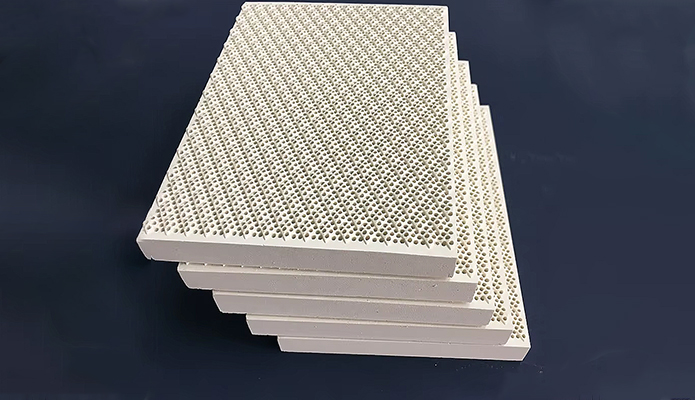
How Cell Density and Channel Size Affect Performance
Cell density and channel size have a direct effect on honeycomb performance.
A higher cell density means more channels in the same area. This can increase the contact area between the gas and ceramic. However, it may also increase resistance to gas flow.
Channel size has a similar effect. Smaller channels can increase the contact area. Larger channels can make gas flow easier.
Wall thickness also needs to be considered. Thin walls can reduce weight and increase the open area. But the ceramic still needs enough strength for handling and use.
Buyers should therefore provide more than the outside dimensions when asking for a quotation. Gas flow, temperature, installation method, and mechanical load are also useful information.
When to Choose Custom Mullite Honeycomb Ceramics
Standard products can work well when the equipment uses common sizes. Some projects need a different shape or size.
In these cases, custom mullite honeycomb ceramics can be made for the actual equipment.
Customization may include:
Overall dimensions
Cell density
Channel size
Wall thickness
Shape
Mounting requirements
The production process also matters. Honeycomb ceramics need careful forming and firing. Size changes can happen during firing. Good process control helps keep the final product close to the required dimensions.
Installation should also be considered before production. The ceramic needs proper support. Strong local pressure should be avoided.
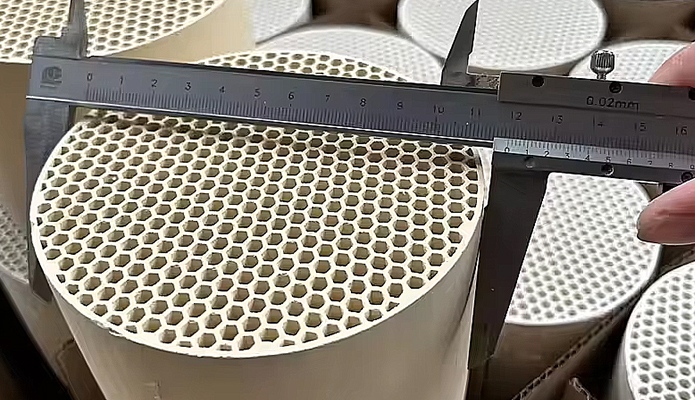
What to Consider When Choosing a Mullite Honeycomb Ceramics Supplier
A good mullite honeycomb ceramics supplier should understand both the material and the application.
Buyers should first confirm the working temperature. They should also provide the required dimensions and cell structure.
Other useful information includes:
| Factor | Information to Provide |
| Working temperature | Normal and maximum temperature |
| Gas flow | Flow rate and direction |
| Cell size | Required channel size or cell density |
| Dimensions | Length, width, height, or custom shape |
| Thermal cycling | Heating and cooling conditions |
| Installation | Support and mounting method |
| Working environment | Dust and chemical exposure |
| Quantity | Trial or production quantity |
This information helps the supplier recommend a suitable product. It also reduces the risk of choosing a product that fits the equipment but does not suit the working conditions.
Mullite honeycomb ceramics should be selected based on both material and structure. Temperature, gas flow, cell size, wall thickness, and installation conditions all matter.
When standard products do not fit the equipment, custom mullite honeycomb ceramics can be considered. For buyers, a mullite honeycomb ceramics supplier should be able to discuss the material, size, structure, and actual application before production.
Online Message
RELATED PRODUCTS

LAR’s Wear resistant ceramic liners & lining are engineered protection systems used in equipment exposed to heavy abrasion and impact. These wear resistant ceramic liners & lining solutions are widely applied in mining, cement, power, and bulk material industries. Many operators choose wear resistant ceramic liners & lining to extend equipment life and maintain stable production. LAR’s Wear resistant ceramic lining forms a hard and smooth surface inside equipment such as chutes, hoppers, and pipelines. This wear resistant ceramic lining reduces friction and limits material erosion during high-speed transport. Abrasion resistant linings are designed for areas where sliding wear and particle impact occur simultaneously. LAR’s Wear resistant ceramic liner components are installed in high-wear zones for targeted protection. Each wear resistant ceramic liner is produced with precise dimensions to ensure tight fitting and easy replacement. Manufacturers combine abrasion resistant linings with steel or rubber backing systems to improve overall durability. LAR’s Wear resistant ceramic liners & lining systems perform reliably in harsh environments with continuous material flow. Many users select wear resistant ceramic liner designs to reduce downtime and maintenance costs.
LAR’s silicon Carbide Honeycomb is a high-performance ceramic material used in high-temperature and filtration applications. The product features a uniform honeycomb structure with straight and parallel channels. This design increases surface area and improves heat transfer efficiency. Silicon Carbide Honeycomb provides excellent thermal stability and high heat transfer efficiency. The structure contains many uniform channels, which improves fluid distribution and heat exchange performance. Many industries use silicon carbide honeycomb in heat exchangers, burner systems, and catalyst supports. LAR’s high purity silicon carbide improves thermal conductivity and mechanical strength. The honeycomb structure also reduces pressure drop during gas or liquid flow. This helps improve energy efficiency in industrial systems. Manufacturers produce each Silicon Carbide Honeycomb through extrusion and high-temperature sintering. The final structure is stable and durable, with a density reduction of about 5–6%. Many industries choose custom silicon carbide honeycomb to meet specific performance and dimensional requirements. A reliable silicon carbide honeycomb supplier can ensure consistent quality and precise specifications.
LAR’s alumina honeycomb ceramics are high-temperature materials used in filtration, heat exchange, and catalyst support systems. The product features a uniform honeycomb structure with straight and parallel channels. This design increases surface area and supports efficient gas flow. Manufacturers produce each alumina honeycomb through extrusion and high-temperature sintering. The final structure remains stable and durable, with a density reduction of about 5–6%. Many industries select custom alumina honeycomb ceramics to match specific operating conditions and equipment designs. LAR’s alumina Honeycomb Ceramics provide stable thermal performance and efficient heat exchange. The structure contains uniform channels that help improve airflow distribution. Many industries use alumina honeycomb ceramics in burners, heat exchangers, and filtration systems.High purity alumina improves thermal stability and mechanical strength. The honeycomb design reduces pressure drop and supports efficient gas flow. This helps improve energy efficiency in industrial processes.
LAR’s mullite honeycomb ceramics are advanced refractory materials used in high-temperature filtration and heat exchange systems. The product features a multi-channel honeycomb structure with straight and uniform passages. This design increases surface area and improves airflow efficiency. Manufacturers produce each Mullite honeycomb through extrusion and high-temperature sintering. Many industries choose custom Mullite honeycomb ceramics to match specific equipment and operating conditions. LAR’s mullite Honeycomb Ceramics provide stable thermal resistance and good structural strength. The honeycomb structure supports uniform airflow and efficient heat exchange. Many industries use mullite honeycomb ceramics in regenerative thermal systems and industrial burners.Mullite material offers low thermal expansion and good thermal shock resistance. This helps the product maintain stability during rapid temperature changes. The porous channel design also improves gas distribution efficiency.
LAR’s heat exchanger honeycombs are advanced ceramic structures designed for efficient heat transfer and thermal management. These heat exchanger honeycombs feature a uniform multi-channel design that provides a large surface area and low airflow resistance. Many industries use heat exchanger honeycombs to improve heat exchange efficiency and reduce energy consumption. LAR’s ceramic honeycomb heater products are often developed based on this structure. A ceramic honeycomb heater uses the honeycomb channels to distribute heat evenly and maintain stable temperature output. Honeycomb ceramic heater plate designs provide a flat and compact configuration that is suitable for heating systems and thermal equipment. Manufacturers produce heat exchanger honeycombs through extrusion and high-temperature sintering processes. This method ensures precise channel geometry and consistent wall thickness. Custom ceramic honeycomb heater solutions allow users to tailor dimensions and cell density for specific heating requirements. LAR’s heat exchanger honeycombs perform reliably in high-temperature environments where efficient heat transfer is essential. Many users choose honeycomb ceramic heater plate structures to achieve uniform heating and long service life.
LAR’s zirconia honeycomb ceramics are advanced structural materials designed for high-temperature and corrosive environments. These zirconia honeycomb ceramics feature a uniform honeycomb structure that provides excellent thermal stability and mechanical strength. Many industries choose zirconia honeycomb ceramics to achieve reliable performance in demanding applications. LAR’s zirconia honeycomb ceramics use high-purity zirconium oxide as the primary material. This composition offers strong resistance to thermal shock and chemical attack. A professional zirconia honeycomb ceramics supplier ensures that each product maintains consistent cell structure and dimensional accuracy. Custom zirconia honeycomb ceramics solutions allow users to define cell density, wall thickness, and overall dimensions. Manufacturers adjust these parameters to meet specific process requirements. Zirconia honeycomb ceramics perform well in environments where rapid temperature changes and aggressive media are present. Many users rely on a trusted zirconia honeycomb ceramics supplier to ensure long service life and stable operation. Custom zirconia honeycomb ceramics provide optimized solutions for complex industrial systems.
LAR’s catalyst carrier honeycombs are advanced ceramic structures designed to support catalytic reactions in high-temperature and high-flow environments. These catalyst carrier honeycombs feature a uniform channel structure that provides a large specific surface area and low flow resistance. Many industries use catalyst carrier honeycombs to improve reaction efficiency and gas distribution. LAR’s heat exchanger honeycombs are often integrated into catalytic systems to enhance thermal management. These heat exchanger honeycombs help control temperature distribution during reactions. Ceramic honeycomb heat exchanger designs allow efficient heat transfer while maintaining structural stability. Manufacturers produce catalyst carrier honeycombs using extrusion technology. This process creates precise channel geometry and consistent wall thickness. An extruded honeycomb heat exchanger structure improves flow uniformity and heat exchange efficiency. LAR’s catalyst carrier honeycombs perform well in applications that require high thermal stability and chemical resistance. Many users choose ceramic honeycomb heat exchanger solutions to improve system performance and extend service life.
LAR’s ceramic honeycomb heaters are high-efficiency heating components designed for industrial thermal systems. These products use a structured honeycomb ceramic body to support stable heat generation and distribution. The ceramic honeycomb heater provides uniform temperature output and reliable performance in continuous heating environments. Manufacturers design each honeycomb ceramic heater plate as the main functional surface for energy transfer. The plate structure helps air and heat flow evenly through the channels. This design improves heating efficiency and reduces energy loss during operation. LAR’s ceramic Honeycomb Heater uses a porous honeycomb structure to achieve fast and uniform heating. The design increases heat transfer area and improves energy efficiency in industrial heating systems.Ceramic honeycomb heaters are widely used in industrial furnaces, catalytic heating systems, air preheating units, and energy-saving thermal equipment. The structure helps reduce heat loss and supports stable long-term operation.Industrial heating equipment, drying systems, and thermal processing lines often rely on these components for consistent performance. A qualified supplier ensures stable structure, accurate dimensions, and reliable electrical behavior.
