
 English
 Русский
 Español
 Français
 Deutsch
 简体中文
简体中文
 Árabe
Árabe
 Português
 日本語
日本語
 한국어
한국어
 हिंदी
हिंदी
 Prancis
 Türkçe
 Tiếng Việt
 Italiano
 ไทย
ไทย

How to Choose the Right Honeycomb Ceramics for High-Temperature Heat Recovery Systems
Heat recovery equipment may look simple from the outside.
Inside, the ceramic honeycomb can face many problems. These include fast temperature changes, hot gases, dust, vibration, and constant gas flow.
These conditions can damage the ceramic over time.
For example, a ceramic honeycomb may start to crack after many heating and cooling cycles.
In another case, the ceramic may not crack. But dust can block the channels. This can increase pressure drop and reduce heat recovery performance.
From practical experience, these problems often have more than one cause.
The material, cell size, operating temperature, gas flow, and heating cycle all matter.
The right honeycomb ceramics should match the actual working conditions.
Choosing only by material name or maximum temperature is not enough.
A Customer Case: Ceramic Honeycomb Started Cracking
One industrial customer had repeated problems with a ceramic honeycomb.
The customer used it in a high-temperature heat recovery application.
The ceramic worked well at first. But cracks appeared after repeated use.
The customer had already replaced the ceramic several times.
The maintenance team first thought the temperature was too high.
A closer check showed a different problem.
The operating temperature was within the normal range of the material.
The main problem was the large temperature changes.
The temperature changed many times during operation.
The ceramic heated up and cooled down again and again.
This created stress inside the ceramic.
The case showed an important point:
Maximum temperature is not the only factor that affects ceramic life.
Thermal shock and temperature changes are also important.
The material must be suitable for the full working cycle.
Why Can Ceramic Crack at an Acceptable Temperature?
Many buyers ask a simple question:
“If the ceramic can handle our temperature, why did it crack?”
The answer is often related to temperature changes.
Ceramic expands when it gets hot.
It contracts when it cools.
If different parts of the honeycomb heat and cool at different speeds, stress can build up inside the ceramic.
Several conditions can make this problem worse:
Fast heating
Fast cooling
Uneven gas flow
Large temperature differences
Poor installation
Mechanical vibration
Dust inside the channels
For this reason, buyers should look at the complete operating cycle.
The startup process is important.
The shutdown process is also important.
In some applications, startup and shutdown can cause more stress than normal operation.
Another Problem: Pressure Drop Becomes Too High
Cracking is not the only problem.
One customer had a different issue.
The ceramic honeycomb was still in good condition. But gas flow became more difficult over time.
The pressure drop increased.
The operators needed more effort to keep the required gas flow.
The team did not replace the ceramic immediately.
First, they checked the gas path.
They found dust and small particles inside the channels.
Some channels were partly blocked.
This reduced the open flow area.
The case shows that high pressure drop does not always mean the ceramic material is bad.
Before replacing the honeycomb, check:
Is there dust inside the channels?
Does the gas contain too much dust?
Is the cell size suitable for the gas?
Is the gas flow even?
Has the ceramic changed shape?
Finding the cause first can help avoid repeated replacement.
Cell Size Is Also Important
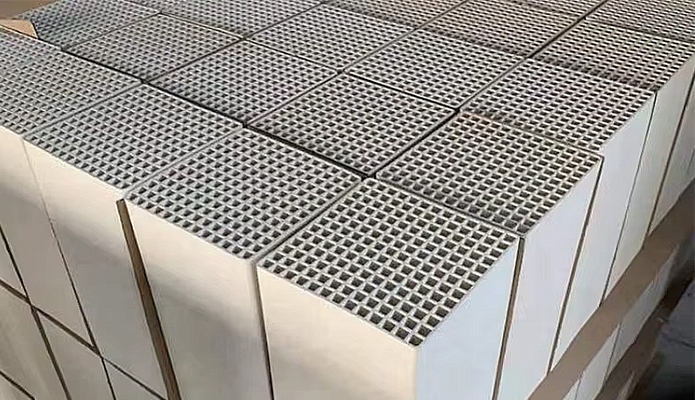
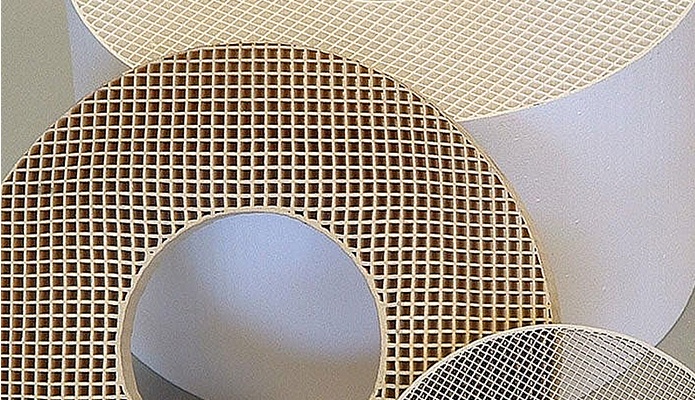
When buyers compare honeycomb ceramic products, they often look at material and size.
Cell size is also important.
Small cells provide more surface area.
But they can also make gas flow harder.
They may also block more easily when the gas contains dust.
Large cells allow gas to pass more easily.
But they may provide less surface area for some heat transfer applications.
There is no single cell size that is best for every application.
The right choice depends on:
Gas flow
Heat transfer needs
Dust level
Pressure drop
Cleaning method
Operating temperature
A good honeycomb ceramic supplier should ask about these conditions before making a recommendation.
Choosing Cordierite, Mullite, Alumina, or Silicon Carbide
Different ceramic materials have different properties.
Cordierite is often used when good thermal shock resistance and cost control are important.
Mullite can be used when good high-temperature stability is needed.
Alumina offers high-temperature performance and good chemical stability in suitable conditions.
Silicon carbide offers high thermal conductivity, good thermal shock resistance, and high mechanical strength.
But material names alone are not enough.
The working conditions must also be checked.
For example, a customer may choose a higher-grade ceramic because the temperature is high.
But if the real problem is dust blockage or poor gas flow, a different material may not solve the problem.
The first step should always be to find the real cause.
What Should Be Checked Before Choosing a Solution?
A good supplier should first understand the application.
The first question should not be:
“Which product should we sell?”
A better question is:
“Why is the current ceramic failing?”
The following information can help:
Working temperature
Temperature changes
Gas composition
Gas speed
Dust level
Pressure requirements
Cleaning method
Installation method
Startup and shutdown cycles
Photos of damaged ceramic can also help.
The position of a crack can provide useful information.
For example, cracks in one area may be related to uneven heating.
Other cracks may be caused by mechanical pressure or poor installation.
This information can help avoid replacing a failed product with another product that has the same problem.
Installation Is Also Important
Installation is easy to overlook.
Ceramic is hard and can handle high temperatures.
But it can still be damaged by strong mechanical pressure.
If the honeycomb is installed too tightly, there may not be enough space for thermal expansion.
The ceramic may then crack when it gets hot.
Uneven support can also create local stress.
This stress can damage one part of the honeycomb.
In some projects, the ceramic material is not the main problem.
The installation method needs to be checked.
The support points should be even.
Enough space should also be provided for thermal movement.
A simple installation change can sometimes help extend ceramic life.
What Can We Learn from Repeated Failure?
Repeated failure provides useful information.
If the ceramic always fails in the same area, that area should be checked carefully.
If cracks appear soon after startup, thermal shock may be the cause.
If cracks appear after long operation, other factors may need to be checked.
These may include chemical attack, long-term heat exposure, or mechanical stress.
If pressure drop slowly increases, dust may be blocking the channels.
If damage only appears near the gas inlet, gas flow or particle impact may be the cause.
The damage pattern can tell engineers a lot.
It can sometimes provide more useful information than a product data sheet.
Customer Feedback
One customer changed its approach after reviewing the operating conditions.
The customer first thought that a different ceramic material was needed.
After checking the equipment, the team found that temperature changes and installation also played an important role.
The customer said:
“We first thought we needed a different material. After checking the working conditions, we found that installation and temperature changes were also part of the problem.”
This shows why application information is important.
A good honeycomb ceramics solution is not only about the ceramic material.
The ceramic must also work well with the equipment and operating conditions.
For formal publication, this customer statement should be replaced with verified feedback from the actual project.
How to Reduce Ceramic Replacement Costs
Frequent replacement is often a sign of a deeper problem.
Before ordering new ceramic honeycomb, record the following information:
Where the damage happened
When the damage appeared
Working temperature
Recent production changes
Pressure drop
Gas composition
Dust level
Startup and shutdown frequency
This information can help find the cause of the problem.
It can also help the supplier choose a more suitable product.
A small amount of useful data can reduce repeated testing and replacement.
Why Supplier Experience Matters
A supplier can provide material grades, sizes, and product data.
But high-temperature applications need more than product information.
The supplier should also understand how the ceramic works inside the equipment.
This is important for heat recovery applications.
LAR provides honeycomb ceramics and other ceramic products for high-temperature industrial applications.
The products can be used in areas such as heat recovery, gas treatment, and filtration.
The main goal is not simply to provide a catalog product.
The supplier should first understand the working conditions.
Then, the material, cell structure, and installation method can be checked together.
Conclusion
Choosing the right honeycomb ceramics is not only about temperature.
Many other factors can affect ceramic life.
These include:
Temperature changes
Gas flow
Pressure drop
Dust
Installation
Material choice
Cell size
Cordierite, mullite, alumina, and silicon carbide each have their own advantages.
But the best choice depends on the actual application.
The first step is to find the cause of the problem.
Then, choose the right material and cell structure.
For companies looking for a honeycomb ceramic supplier, this approach can help reduce repeated replacement and improve equipment performance.
Check the working conditions first. Find the cause. Then choose the right ceramic.
Online Message
RELATED PRODUCTS

LAR’s Wear resistant ceramic liners & lining are engineered protection systems used in equipment exposed to heavy abrasion and impact. These wear resistant ceramic liners & lining solutions are widely applied in mining, cement, power, and bulk material industries. Many operators choose wear resistant ceramic liners & lining to extend equipment life and maintain stable production. LAR’s Wear resistant ceramic lining forms a hard and smooth surface inside equipment such as chutes, hoppers, and pipelines. This wear resistant ceramic lining reduces friction and limits material erosion during high-speed transport. Abrasion resistant linings are designed for areas where sliding wear and particle impact occur simultaneously. LAR’s Wear resistant ceramic liner components are installed in high-wear zones for targeted protection. Each wear resistant ceramic liner is produced with precise dimensions to ensure tight fitting and easy replacement. Manufacturers combine abrasion resistant linings with steel or rubber backing systems to improve overall durability. LAR’s Wear resistant ceramic liners & lining systems perform reliably in harsh environments with continuous material flow. Many users select wear resistant ceramic liner designs to reduce downtime and maintenance costs.
LAR’s silicon Carbide Honeycomb is a high-performance ceramic material used in high-temperature and filtration applications. The product features a uniform honeycomb structure with straight and parallel channels. This design increases surface area and improves heat transfer efficiency. Silicon Carbide Honeycomb provides excellent thermal stability and high heat transfer efficiency. The structure contains many uniform channels, which improves fluid distribution and heat exchange performance. Many industries use silicon carbide honeycomb in heat exchangers, burner systems, and catalyst supports. LAR’s high purity silicon carbide improves thermal conductivity and mechanical strength. The honeycomb structure also reduces pressure drop during gas or liquid flow. This helps improve energy efficiency in industrial systems. Manufacturers produce each Silicon Carbide Honeycomb through extrusion and high-temperature sintering. The final structure is stable and durable, with a density reduction of about 5–6%. Many industries choose custom silicon carbide honeycomb to meet specific performance and dimensional requirements. A reliable silicon carbide honeycomb supplier can ensure consistent quality and precise specifications.
LAR’s alumina honeycomb ceramics are high-temperature materials used in filtration, heat exchange, and catalyst support systems. The product features a uniform honeycomb structure with straight and parallel channels. This design increases surface area and supports efficient gas flow. Manufacturers produce each alumina honeycomb through extrusion and high-temperature sintering. The final structure remains stable and durable, with a density reduction of about 5–6%. Many industries select custom alumina honeycomb ceramics to match specific operating conditions and equipment designs. LAR’s alumina Honeycomb Ceramics provide stable thermal performance and efficient heat exchange. The structure contains uniform channels that help improve airflow distribution. Many industries use alumina honeycomb ceramics in burners, heat exchangers, and filtration systems.High purity alumina improves thermal stability and mechanical strength. The honeycomb design reduces pressure drop and supports efficient gas flow. This helps improve energy efficiency in industrial processes.
LAR’s mullite honeycomb ceramics are advanced refractory materials used in high-temperature filtration and heat exchange systems. The product features a multi-channel honeycomb structure with straight and uniform passages. This design increases surface area and improves airflow efficiency. Manufacturers produce each Mullite honeycomb through extrusion and high-temperature sintering. Many industries choose custom Mullite honeycomb ceramics to match specific equipment and operating conditions. LAR’s mullite Honeycomb Ceramics provide stable thermal resistance and good structural strength. The honeycomb structure supports uniform airflow and efficient heat exchange. Many industries use mullite honeycomb ceramics in regenerative thermal systems and industrial burners.Mullite material offers low thermal expansion and good thermal shock resistance. This helps the product maintain stability during rapid temperature changes. The porous channel design also improves gas distribution efficiency.
LAR’s heat exchanger honeycombs are advanced ceramic structures designed for efficient heat transfer and thermal management. These heat exchanger honeycombs feature a uniform multi-channel design that provides a large surface area and low airflow resistance. Many industries use heat exchanger honeycombs to improve heat exchange efficiency and reduce energy consumption. LAR’s ceramic honeycomb heater products are often developed based on this structure. A ceramic honeycomb heater uses the honeycomb channels to distribute heat evenly and maintain stable temperature output. Honeycomb ceramic heater plate designs provide a flat and compact configuration that is suitable for heating systems and thermal equipment. Manufacturers produce heat exchanger honeycombs through extrusion and high-temperature sintering processes. This method ensures precise channel geometry and consistent wall thickness. Custom ceramic honeycomb heater solutions allow users to tailor dimensions and cell density for specific heating requirements. LAR’s heat exchanger honeycombs perform reliably in high-temperature environments where efficient heat transfer is essential. Many users choose honeycomb ceramic heater plate structures to achieve uniform heating and long service life.
LAR’s zirconia honeycomb ceramics are advanced structural materials designed for high-temperature and corrosive environments. These zirconia honeycomb ceramics feature a uniform honeycomb structure that provides excellent thermal stability and mechanical strength. Many industries choose zirconia honeycomb ceramics to achieve reliable performance in demanding applications. LAR’s zirconia honeycomb ceramics use high-purity zirconium oxide as the primary material. This composition offers strong resistance to thermal shock and chemical attack. A professional zirconia honeycomb ceramics supplier ensures that each product maintains consistent cell structure and dimensional accuracy. Custom zirconia honeycomb ceramics solutions allow users to define cell density, wall thickness, and overall dimensions. Manufacturers adjust these parameters to meet specific process requirements. Zirconia honeycomb ceramics perform well in environments where rapid temperature changes and aggressive media are present. Many users rely on a trusted zirconia honeycomb ceramics supplier to ensure long service life and stable operation. Custom zirconia honeycomb ceramics provide optimized solutions for complex industrial systems.
LAR’s catalyst carrier honeycombs are advanced ceramic structures designed to support catalytic reactions in high-temperature and high-flow environments. These catalyst carrier honeycombs feature a uniform channel structure that provides a large specific surface area and low flow resistance. Many industries use catalyst carrier honeycombs to improve reaction efficiency and gas distribution. LAR’s heat exchanger honeycombs are often integrated into catalytic systems to enhance thermal management. These heat exchanger honeycombs help control temperature distribution during reactions. Ceramic honeycomb heat exchanger designs allow efficient heat transfer while maintaining structural stability. Manufacturers produce catalyst carrier honeycombs using extrusion technology. This process creates precise channel geometry and consistent wall thickness. An extruded honeycomb heat exchanger structure improves flow uniformity and heat exchange efficiency. LAR’s catalyst carrier honeycombs perform well in applications that require high thermal stability and chemical resistance. Many users choose ceramic honeycomb heat exchanger solutions to improve system performance and extend service life.
LAR’s ceramic honeycomb heaters are high-efficiency heating components designed for industrial thermal systems. These products use a structured honeycomb ceramic body to support stable heat generation and distribution. The ceramic honeycomb heater provides uniform temperature output and reliable performance in continuous heating environments. Manufacturers design each honeycomb ceramic heater plate as the main functional surface for energy transfer. The plate structure helps air and heat flow evenly through the channels. This design improves heating efficiency and reduces energy loss during operation. LAR’s ceramic Honeycomb Heater uses a porous honeycomb structure to achieve fast and uniform heating. The design increases heat transfer area and improves energy efficiency in industrial heating systems.Ceramic honeycomb heaters are widely used in industrial furnaces, catalytic heating systems, air preheating units, and energy-saving thermal equipment. The structure helps reduce heat loss and supports stable long-term operation.Industrial heating equipment, drying systems, and thermal processing lines often rely on these components for consistent performance. A qualified supplier ensures stable structure, accurate dimensions, and reliable electrical behavior.
